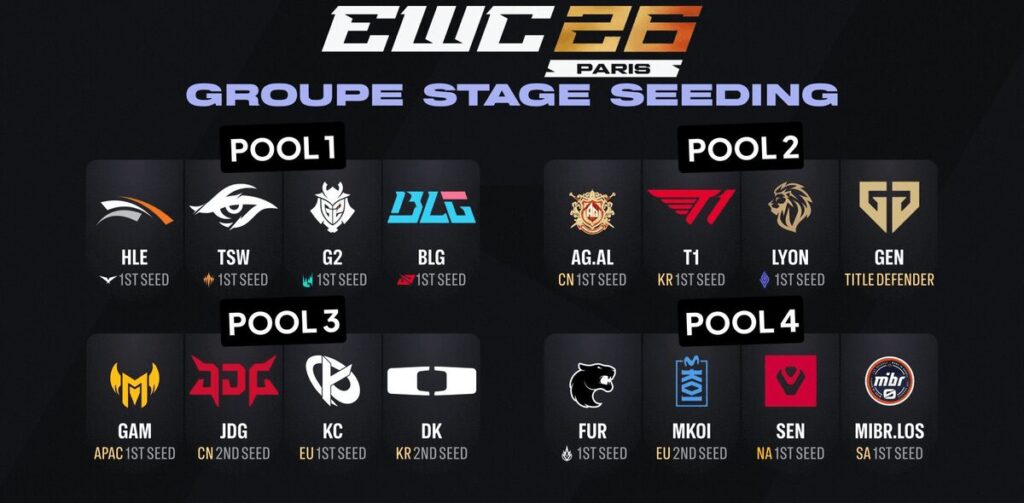
This year, Paris has become one of the main hubs for esports. The city hosted the Esports World Cup 2026, which had originally been scheduled to take place in Riyadh. The League of Legends tournament proved particularly spectacular, with European teams taking on their Asian counterparts. A distinctive feature of the EWC 2026 is the high density of matches and the calibre of the opponents. Over the course of just a few days of competition, teams can face representatives from the LEC, EMEA, LCS and LCK. For coaching staff, this is an opportunity to test their strategies, whilst for fans, it’s a chance to see who is truly ready to compete for international titles.
Why Paris Roadshow Changes Team Evaluation
In traditional regional leagues, it is not always possible to objectively assess the strength of a squad. Usually, such tournaments feature two or three strong teams, with the rest being of average standard. Consequently, some teams may be undisputed leaders in their domestic league, yet fail to even qualify for the play-offs at international level. A similar situation can be seen in the lol summer split 2026, which is one of the main tournaments of this part of the season. The LEC and LCS have clear frontrunners, but will they be able to compete just as successfully for the title at Worlds?
Karmine Corp are currently 3–0 in the LEC, whilst in the LCS, Team Liquid lead with a 1–1 record after the first round. Given these results, the teams’ prospects for upcoming tournaments look promising. However, it’s important to maintain top form over the long haul of the season; one need only recall how G2 Esports or Gen.G, in different seasons, displayed a completely different standard of play after just a few matches against stronger opponents.
The psychological component is no less important. Young teams often perform confidently in national leagues, but on big stages, due to nervousness and the pressure of fans’ expectations, they may play below the expected level. It is precisely the summer split tournaments that allow coaches to assess who is capable of performing consistently under pressure.
How Summer Competition Reveals Real Contenders
The summer part of the LoL season is the most telling when it comes to assessing teams’ levels. By this point, most teams have already played dozens of official matches, established a stable champion pool and honed their teamwork. That is precisely why the results of summer tournaments carry significantly more weight than the first matches following the off-season.
During this period, the difference between teams that win through individual skill and those with well-rehearsed tactics becomes particularly apparent. Whilst at the start of the season a single player might still decide the outcome of a match, at major S-tier tournaments no one will risk playing that way. Victories are mostly secured by teams that utilise map vision more effectively, trade off global objectives at the right time, and react more quickly to changes in the pace of the game.
In the gaming community, users share thoughts regarding the summer LEC matches. One of the main points is the importance of macro skills, which some teams forget. Often, it is the macro play that distinguishes a professional team from amateurs.
Adaptation Matters More Than Individual Skill
Returning to the topic of the LoL EWC 2026, it is worth mentioning the importance of adaptation. After the first matches of the tournament, professional analysts focused not on the standings, but on how quickly the teams were adapting. Overall, the European teams were slightly behind their Korean counterparts in this respect. They were too focused on traditional game set-ups and quickly became predictable, even though they had strong players in every position.
One exception was the French team Karmine Corp. Apart from their opening defeat against Gen.G, they displayed a high standard of play and delighted the local crowd who were cheering them on. Ultimately, Karmine Corp reached the Grand Final and finished as runners-up in the tournament.
Another pattern was also noticeable at EWC 2026. The best results are shown not by the teams that win all the early skirmishes, but by those that minimize the number of strategic mistakes after the twentieth minute. Controlling Baron Nashor, properly preparing for the Elder Dragon spawn, skillful use of teleports, and distributing resources among core players often determine the outcome much more than individual moments.
Special attention deserves the work of analytical teams. After each game day, they review dozens of replays, compare their own statistics with those of their opponents, and determine which decisions should be kept and which should be abandoned.
What European Teams Should Learn Before Worlds
Every season confirms the same pattern: the path to a successful performance at LoL Worlds begins long before the tournament kicks off. At EWC 2026, European organisations put their readiness to the test against a variety of playstyles. Despite the mixed results, the experience gained will certainly prove useful and help secure more victories in the future.
The first lesson teams should take away from such tournaments is the need for quick decision-making. At international level, even a pause of just a few seconds often leads to the loss of a key objective or a lost team fight. Experienced line-ups exploit this factor to the full, forcing their opponents to act under constant pressure.
It is also worth not underestimating physical training. A busy schedule of international competitions, flights, and a large number of training sessions noticeably affects concentration. Large organizations are increasingly involving sports psychologists, physical training specialists, and recovery experts to maintain a stable level of play throughout the season.
Another conclusion relates to the work of management. Successful clubs evaluate not only results but also the potential of the roster to develop during the season. For example, teams like T1, G2, or Natus Vincere value stability. Even if a team performed poorly in one tournament, it does not become a reason for radical changes. A long-term development approach helps to reach peak form directly for major tournaments and achieve good results.
Conclusion
The LoL summer season is packed with a host of major tournaments, ranging from the MSI to the EWC. For European teams, this is an opportunity to get a fair assessment of their own level, test the effectiveness of new line-ups and identify weaknesses ahead of the season’s most important championships. Results in these tournaments do not guarantee success at Worlds, but they do indicate the direction in which each organisation is heading. Teams that use the experience gained to improve will have a much better chance of performing well at the year’s main League of Legends tournament.
About The Author