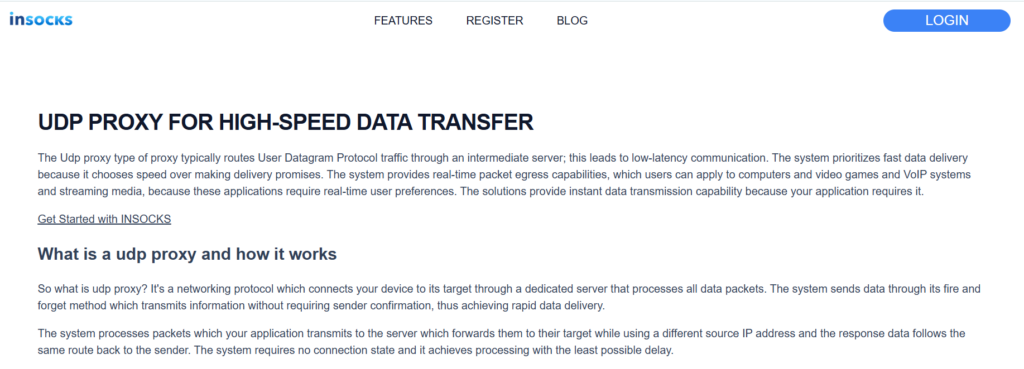
Network teams often get better results when they stop treating all traffic as if it should travel the same way. On the INSOCKS product page, a UDP proxy is presented as a tool for packet based workloads where speed, direct routing, and low overhead matter more than strict delivery confirmation, which makes it especially useful for gaming, VoIP, streaming, telemetry, and similar live services. That means the product is most valuable when it is used to separate real time flows from reliability critical flows rather than being dropped into every stack by default. The strongest operational gain comes from designing clearer traffic boundaries before deployment instead of fixing protocol mismatches after users start complaining. ✨
Why service separation matters
When one network path is forced onto every workload, live traffic and reliability critical traffic start to work against each other. The INSOCKS page explains that UDP sends data without connection state or sender confirmation, which lowers delay, but it also states that this model does not guarantee delivery or order. That tradeoff is useful only when the application can tolerate it.
A cleaner architecture begins by recognizing that not every business system has the same tolerance for packet loss or reordering. The page presents gaming, voice, streaming, real time analytics, telemetry, and IoT as natural fits because these systems often value timeliness over perfect completeness. By contrast, the same page says file transfers, web browsing, and financial transactions should not rely on this route type because they need reliable ordered delivery.
|
Service category |
Better fit for UDP routing |
Why this boundary helps |
|
Competitive gaming |
Yes |
Instant state updates benefit from minimal delay and can tolerate some imperfection |
|
VoIP and voice sessions |
Yes |
Live audio depends on fast delivery more than on retransmission |
|
Streaming support flows |
Yes |
Continuous media related traffic benefits from lighter overhead |
|
Telemetry and IoT readings |
Yes |
Large volumes of readings often value timeliness over every single packet |
|
File transfer workloads |
No |
Missing packets can corrupt results and the page says this is not the right fit |
|
Web browsing and transactions |
No |
The page says HTTP browsing and financial operations need reliable transport |
Live systems benefit when delay is the first priority
The product page repeatedly ties UDP routing to gaming, VoIP, and streaming because these are systems where delay quickly becomes visible to users. In those cases, a small amount of packet loss can be less damaging than slow delivery, and the page explicitly frames this as the reason the protocol remains useful. This makes the route especially relevant for user facing services where responsiveness is part of product quality.
Critical data systems need another lane
The same page is equally clear that some categories do not belong on this route at all. File transfers, browsing, and financial transactions are listed as poor matches because the protocol does not guarantee delivery or order, and those services depend on exactly that kind of reliability. Good network design therefore keeps these workloads on more reliable paths instead of forcing them into a low latency model that was built for different priorities. ❌
One service stack can still contain both models
A useful takeaway for operations is that a company does not need to choose one philosophy for all traffic. It can keep live packet services on a route optimized for lower delay while preserving stricter delivery rules for web and transaction flows. The INSOCKS page supports this way of thinking because it defines the product by compatible traffic patterns rather than by broad generic claims. ✨
How INSOCKS supports event driven workloads
The page describes the UDP offer as infrastructure built specifically for latency sensitive applications, with optimized routing, minimal overhead, and direct paths to major gaming and streaming endpoints across the USA. It also states that packet loss, jitter, and latency are monitored continuously and that routing adapts when conditions change. That combination shows that the service is aimed at event driven workloads rather than at ordinary browser traffic.
This matters because event driven services tend to fail in ways that ordinary web services do not. A small rise in jitter, a routing detour, or unnecessary overhead can damage user experience long before a full outage appears. By focusing on direct routing, sub 10ms overhead, multiple USA servers, and continuous monitoring, the page positions the infrastructure around those live service risks. ✅
Direct routing supports time sensitive behavior
The feature section says the service uses direct routing and keeps overhead below 10 milliseconds, while also listing native datagram traffic for gaming, VoIP, and streaming. These claims matter because event driven services usually care about accumulated path delay more than about abstract bandwidth claims. A route that stays short and direct is often more useful than one that is merely fast on paper.
Continuous monitoring helps preserve service quality
The infrastructure section says INSOCKS watches packet loss, jitter, and latency continuously and adjusts routing when conditions change. That is especially relevant in event driven systems because degradation often appears gradually before users describe it as a full incident. A provider that treats packet quality as a live operational metric is easier to align with real time service expectations. ✨
Hosting and reverse paths expand the design options
The practical tips section recommends using a UDP reverse proxy for hosting services that accept incoming connections. This creates a wider design space than simple client side routing because some real time services need controlled inbound traffic as part of their architecture. A team can therefore use the product not only as an outbound performance tool but also as part of a more structured service edge
Comparing UDP with more reliable transport choices
A strong deployment plan needs a comparison stage before it needs a test stage. The page itself compares UDP with TCP and HTTP and explains that the difference is fundamental rather than cosmetic: TCP and HTTP add connection establishment and stronger delivery behavior, while UDP removes that overhead in exchange for less reliability. That makes comparison a planning step, not a marketing exercise.
|
Traffic model |
Best used when |
Main strength |
Main limitation |
|
UDP route |
Delay matters more than perfect delivery |
Minimal overhead and fast packet forwarding |
No guaranteed delivery or order |
|
TCP or HTTP route |
Reliability and ordered delivery are critical |
Better fit for browsing files and transactions |
More connection overhead and latency |
|
SOCKS based handling |
Mixed or configurable environments |
Broader compatibility in some setups |
UDP support can vary by implementation |
UDP is not a replacement for reliable transport
The page never presents the product as universally better than TCP or HTTP. Instead, it says those models remain dominant for web traffic because browsers and dependable transactions require reliable connections. This is useful because it encourages teams to treat UDP as a specialized lane rather than as a fashionable default. ✅
SOCKS support requires a more careful reading
The page notes that SOCKS5 can technically handle this kind of traffic, but it also says implementation varies and that native solutions built for connectionless protocols can be more consistent. That means mixed environments need extra care when they rely on generic proxy logic for packet driven workloads. A purpose built route can therefore be simpler than trying to force compatibility where it is partial.
Comparison prevents wrong expectations later
Most live traffic complaints become harder to fix when the original transport choice was wrong. A team that tries to use a low latency route for reliability critical workloads will keep blaming the route for behavior it was never designed to provide. Clear comparison early helps prevent that confusion and leads to better service segmentation later. ✨
Step by step guide for cleaner deployment boundaries
A good deployment plan should decide protocol fit before it decides budget or scale. The INSOCKS page gives enough information to build a small but useful deployment checklist centered on workload type, route distance, packet quality, and rules for early correction. That keeps the product aligned with live service design instead of leaving it as a last minute fix.
Step one classify the service before buying the route
Start by deciding whether the service is event driven or reliability critical. If it looks more like gaming, voice, streaming, telemetry, or similar live packet traffic, the page suggests it belongs in the UDP lane; if it looks more like browsing, file transfer, or transaction handling, it does not. This first choice prevents the most expensive type of mistake, which is solving the wrong problem with the wrong transport. ✅
Step two choose the nearest practical path
The practical tips section recommends geographically close servers, and the feature section highlights multiple USA servers and direct routing. That means distance should be treated as a service design variable rather than an afterthought. In low delay systems, route geography often influences the user experience as much as the application code does.
Step three measure packet quality not just basic connectivity
The page recommends testing latency before committing and monitoring packet loss, while the infrastructure section adds jitter and adaptive routing to the list of operational concerns. This means a clean deployment check should include delay variation and packet health, not merely whether the port responds. Live systems are usually damaged by unstable packet quality sooner than by total outages.
Step four use early support and refund windows properly
The policy says the port is opened for 24 hours, manual refund is available if the proxy goes offline within two hours, and support tickets must be created within five hours when no refund button is present. It also says some complaints such as blacklist status, high fraud score, low anonymity score, or a block on a specific site are not accepted as refund reasons. That makes early service classification and early testing operationally important, not just technically neat. ❌
Informational block for safe operating habits
A specialized route works better when the surrounding habits are just as specialized. The terms and privacy sections state that the service does not log proxy traffic or collect personal user data, but they also reserve the right to monitor connections when prohibited activity is detected. At the same time, the rules forbid spam, public proxy sharing, scanners, bruteforcers, and software that grants third parties access to the proxies.
Recommended habits
- ✅ Keep UDP routes for packet driven services that truly benefit from lower overhead.
- ✅ Test latency, jitter, and packet loss early within the first use window.
- ✅ Choose geographically close servers when live responsiveness matters.
- ✅ Use history and the Exclude used proxies filter to avoid repeating weak routes.
Habits to avoid
- ❌ Do not force UDP into file transfers, browsing, or payment workflows.
- ❌ Do not delay support tickets past the five hour claim window.
- ❌ Do not use the service for spam, scanners, port attacks, or public sharing.
- ❌ Do not assume a route is production ready just because the port opened successfully.
Pros and cons for service architecture teams
The strongest benefit of this product is architectural clarity. It gives a team a dedicated lane for event driven traffic, direct routing, monitored packet quality, multiple USA server options, and support for reverse proxy style hosting use cases. That makes it easier to build a cleaner separation between live packet services and reliability first services. ✅
The tradeoff is equally clear and should stay visible. The page says the protocol does not guarantee delivery or order and is not meant for transactions, browsing, or transfers, while the refund policy also limits what kinds of problems qualify for remediation. This means the product works best when it is selected with discipline and kept inside the service boundaries the site describes. ✨
About The Author